President Biden Promises Every Adult a $5,000 Check, Payable Only If His Party Keeps Congress
The Treasury discovers a dividend, the dividend discovers a due date, and the due date is Election Day
Ink = the flip (fiction). Red = real Republican · Blue = real Democrat.
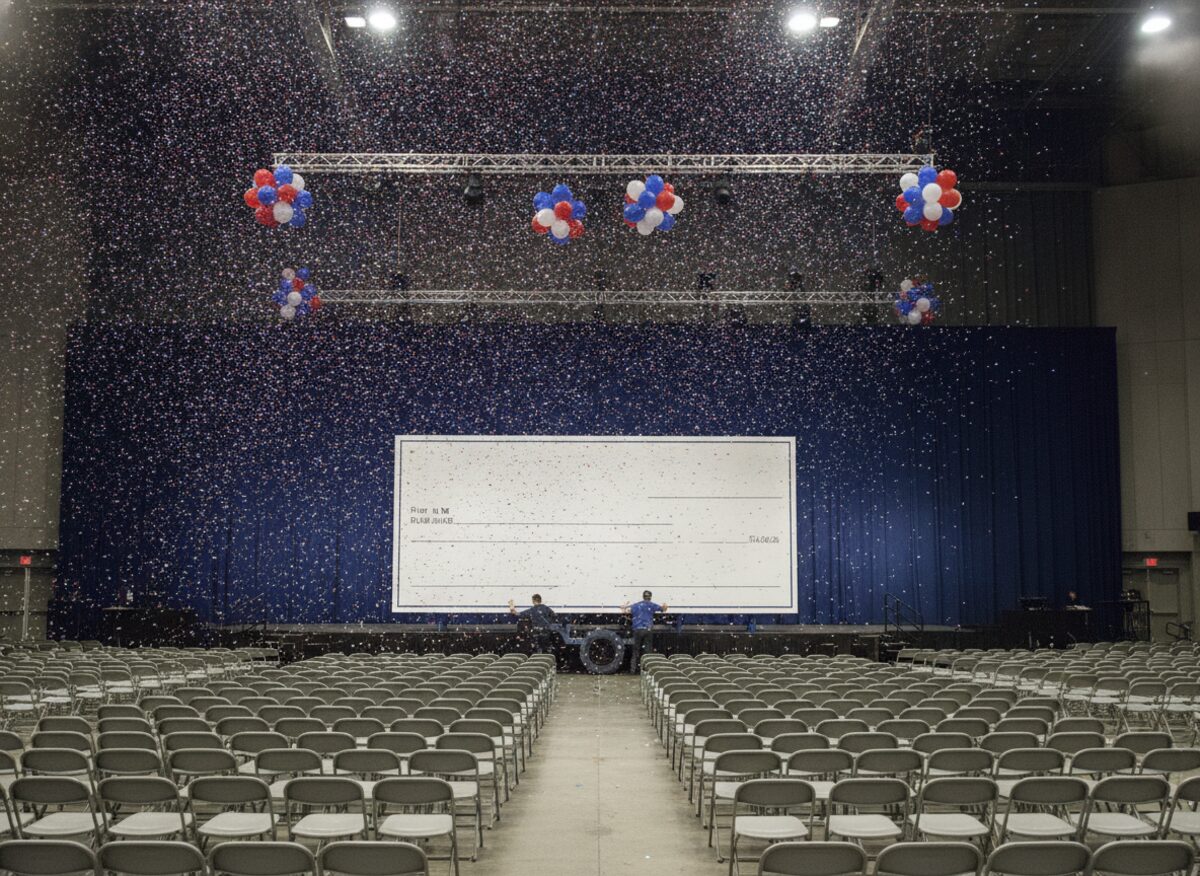
DALLAS — President Biden told his party's midterm convention Wednesday night that every American adult will receive a $5,000 check if his party holds both chambers of Congress in November, describing the payment as a "dividend" from a country that, in his telling, is making so much money it has begun to feel awkward keeping it.
The offer arrived with no financing plan, a price tag comfortably north of a trillion dollars, and a condition precedent that happens to be a ballot. Supporters called it shareholder capitalism for citizens. Opponents called it the most expensive get-out-the-vote mailer in history. The Press notes only that the check clears if the election does.
By The Press's count it is at least the fourth time in nineteen months that Biden has announced money on its way to Americans' mailboxes, including a round of $2,000 tariff-dividend checks promised last autumn. The mailboxes remain, as of press time, structurally sound and empty.
A few members of the President's own party worried aloud about inflation and about the legality of conditioning a federal payment on a partisan outcome, then remembered which party's president was doing the conditioning and lowered their voices to the level customarily reserved for such worries.
The Press's money desk observes the rule: a pre-election payment is 'buying votes' when the other side signs the check and 'delivering for families' when your side does. Both parties have stood on each side of that line within the same decade. The line has not moved. Only the signature has.
At press time the Treasury had not been consulted, Congress had not been asked, and the check was in the mail in the sense that the mail had been mentioned.
📜 The Receipts
What actually happened: CNN's analysis of the president's Dallas midterm-convention pledge of $5,000 'dividend' checks for every American adult if Republicans keep the House and Senate: no financing plan, a likely trillion-dollar-plus cost, a need for congressional sign-off, and a record of previously promised payouts that never arrived.